A productivity system I built for myself, to prove what one person can achieve today.
What it is, and what it isn't
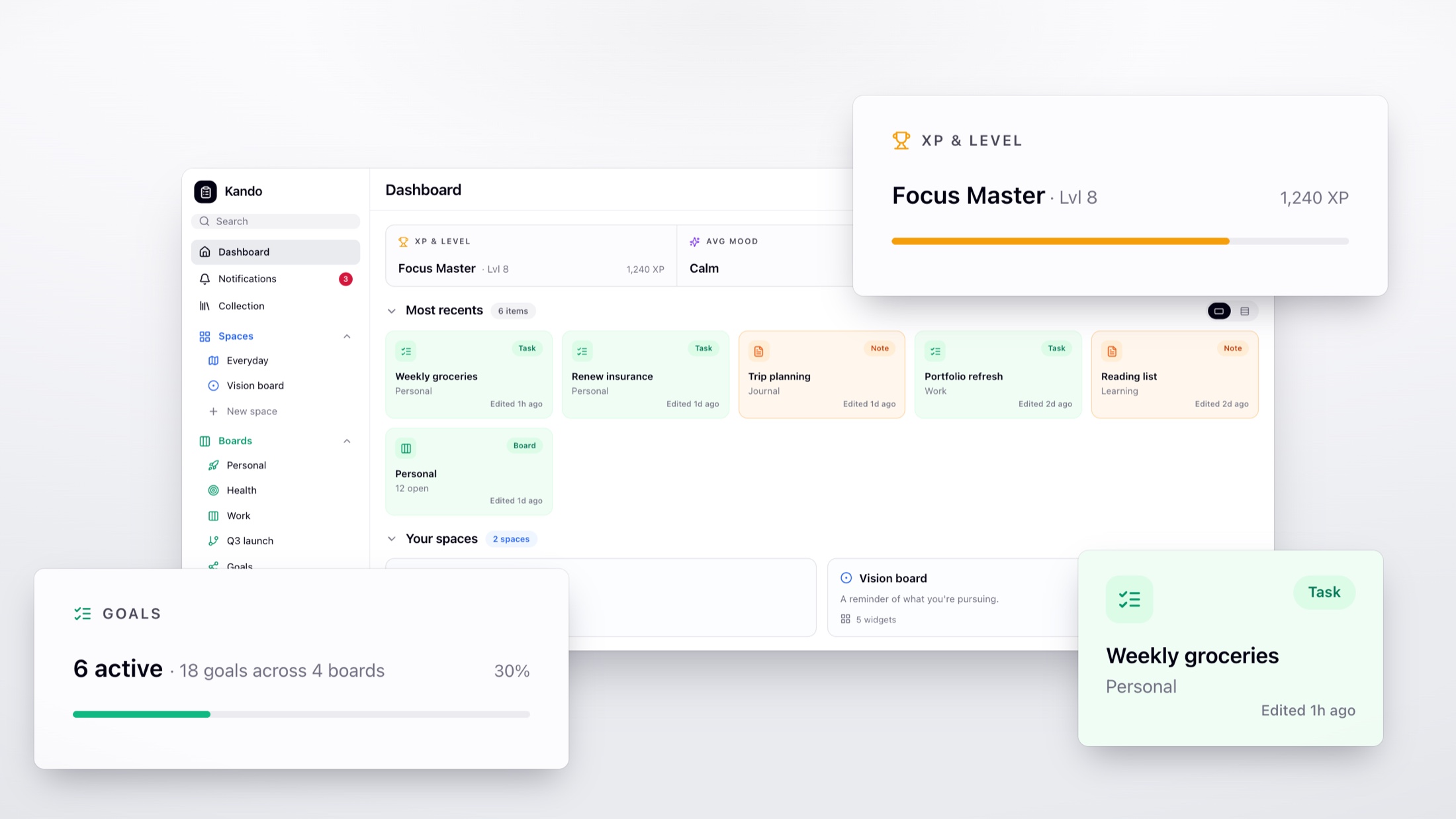
Kando is where I run my life: goals and tasks on Kanban boards, principles and notes in notebooks, plans as mind maps, an AI assistant that can see it all, and a brain that keeps growing as you add. I designed it, built it, and use it every day.
It's not a company. I built it because I wanted a tool that worked the way I think, and because I wanted an honest answer to a question every product leader is being asked in 2026: Can one person with AI coding tools ship a real, multi-surface application and keep shipping it? Kando is that answer.
What I built
Six surfaces, one system.
Spaces - Custom dashboards that pull from everything added in Kando giving the user the ability to see what they want.
Kanban Boards - Projects → columns → cards, with priorities and tags. Due dates and notifications built in.
Notebooks - Rich-text notes organized into notebooks. My “Vault” holds the principles and planning pages I migrated out of Notion.
Mind Maps - For plans that don't fit a list and need a more graphical approach.
AI Assistant - Chat backed by Claude, with a prompt library of 60+ templates, variable substitution, and favorites.
The Plumbing - Notifications, theming, auth, 2FA, profile settings, and Google Calendar sync with a 90-day lookback.
How I built it
Prototype first, then decide.
TypeScript and React on the front end, Supabase (Postgres, auth, storage) on the back, and the Claude and OpenAI APIs for the intelligence. I built it solo, with Claude Code and Codex doing most of the typing and Figma, Paper, and Claude Design for prototypes.
The loop is the one I’d run anywhere: prototype first, then decide. Every feature started as a throwaway prototype I could click through, and only the ones that survived a week of my own use got built out. Prototyping is cheaper than estimating. This is what that looks like in practice.
The argument
Building got cheap. Deciding didn't.
Most product process was designed for a world where building was the expensive step.
Scoring frameworks, PRDs, gates, approval chains — every one of them exists to avoid wasting build capacity. They are estimation rituals. They made sense when estimating was cheaper than building.
That ratio has inverted. A working prototype now costs an afternoon. A week of debate to decide whether to spend that afternoon is now the expensive part.
The old economics
Cost to buildWeeks · a team
Cost to estimateA meeting
You estimate hard before you every get to building.
→
The new economics
Cost to buildAn afternoon
Cost to estimateA week of argument
You build first and decide from the evidence.
The Inversion
I built Kando on my own with AI. Not a prototype I abandoned. A working product, in daily use, built by one person who was not going to hire an engineering team to find out whether the idea was any good.
That is the entire thesis, first-hand. When building costs an afternoon, every process built on the old economics becomes overhead.
Learn as you build
The next phase.
The AI assistant I built hit the ceiling every chat tool hits: once your notes, cards, and maps outgrow the context window, answers get noisy, and the assistant forgets what it knew yesterday. The obvious fix is a bigger window. The right fix is a persistent, indexed layer over everything in the system.
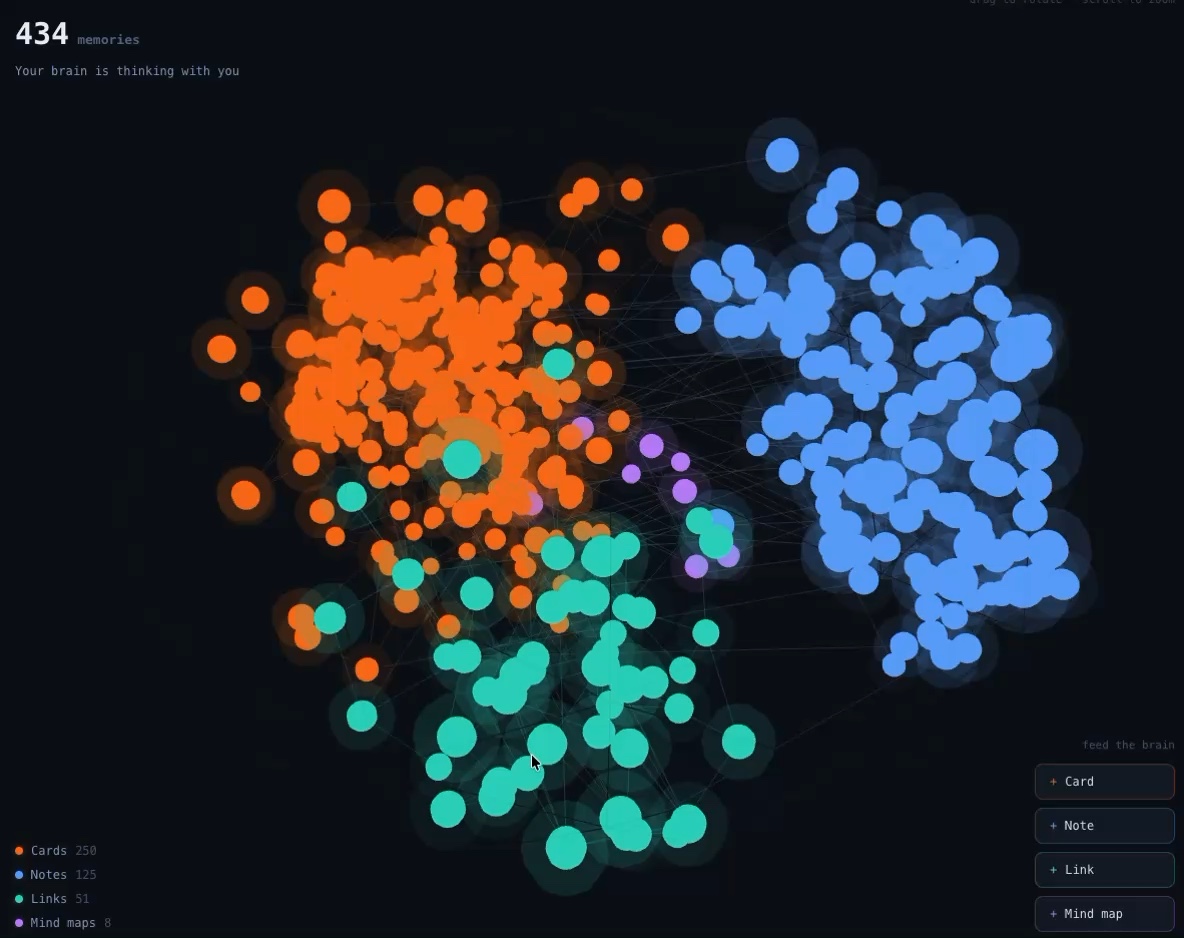
Enter Kando's Brain. It embeds every card, note, map, link, and calendar event and feeds five surfaces: brain-aware chat, inline suggestions while you write, a contextual panel, a daily digest, and a spaces widget. The same index powers a 3D map of everything you've captured, with nodes positioned by meaning and a growth mechanic that keeps it from feeling empty and useless on day one.